International Pluridisciplinary Research Group
Semiotics of the Arts
The Group was established at the Catholic University of Lublin at the end of 2024/beginning of 2025 on the initiative of Professor Małgorzata Gamrat, and is open to motivated researchers interested in the intersection of the arts and semiotics.
In the Group you can meet any and every semiotician dealing with the various arts, and researchers from different areas of the arts who refer to semiotics in their academic works – renowned scholars, young researchers, doctoral candidates, as well as independent scholars from various continents, countries and generations.
The main goal of the research group is interdisciplinary arts research as broadly understood, regardless of its medium (word, sound, image, multimedia, etc.). The most important assumption is the joint work of researchers from different areas of the arts and semiotics, which allows us to look at selected issues from various perspectives, and which can be translated into the development of new research tools through the exchange of experiences. It is also a tool for the integration of researchers working in isolation on individual arts and a deeper understanding of the laws governing art, which, thanks to the tools developed based on semiotics, can be analysed and described together.
Description
Since the Renaissance, theorists and artists have considered in various treatises what connects and what divides the arts, as well as which of them appeal to reason and which move the emotions; these considerations intensified in the 18th century. In the 19th century, in turn, mainly artists (although theorists, too), continuing the considerations of those theorists of the previous century, wondered about those elements that unite the arts, their expressive possibilities, and their ability to affect the imagination. This reflection appears primarily in artistic works. Moreover, artists looked for common elements between the arts, tried to transfer techniques and structures between them, as well as seeking technical means that would allow for the same expressive effects; they co-operated and took up the same topics. All of this translated into enriching the artistic means of each of the arts and their closer co-operation. In the 20th century, the French philosopher Étienne Souriau proposed the creation of a new research discipline that would allow for the study of what unites the arts in their deepest layers. He called this field of research ‘comparative aesthetics’ (esthétique comparée). His ideas were only fully realised at the beginning of the 21st century when researchers from different areas of the arts and aesthetics began working together on a dictionary of aesthetics (Vocabulaire d’esthétique, 2010), in which individual entries were developed from the perspective of different arts. This work did not produce the expected results – fragments of individual entries remain side by side, separate. There was a lack of a common language and elements that would allow for comparisons and the emergence of an understanding between researchers.
Semiotics could be one such common language for research on the connections between the arts. The assumption that every language – including the artistic, not only the verbal – is a tool of communication (i.e. Jakobson), and, consequently, a medium of expression of artists’ sensitivity and their way of perceiving the world, is fundamental for that research. The main semiotic categories – signs and codes – can be indicated in every art, which enables mutual understanding between researchers and indicates the laws governing art, regardless of the medium of communication used by the artists themselves (i.e. Lotman, Tarasti, Mieke Bal, Sebeok, Gorlée, Marais, Petrilli, Torop, Thibault). The validity of this approach has been confirmed by recent semiotic congresses (the World Congress of Semiotics), during which panels devoted to selected issues functioning in various arts enjoyed great interest, and interdisciplinary discussions led by the participants of these panels indicated the great need for such co-operation and the potential of multidisciplinary projects brought together by semiotics.
Our Team
Małgorzata Gamrat
Founder and director
Małgorzata Gamrat is Professor at the John Paul II Catholic University of Lublin, Poland. The main fields of her academic interests include word-and-music studies, the interactions of music with other fields of art (especially literature), French and German culture of the nineteenth century, and the methodology of interdisciplinary research, including semiotics and intermedial translation. Her academic interests also include the oeuvres of Alexander Tansman, Vladimir Jankélévitch, Jean-Baptiste Rousseau, as well as classical and popular music of the twentieth century. Her most recently published books are Franz Liszt’s Songs for Voice and Piano. The Composer’s Approach to Poetry and Music (Brill 2023) and Translating Human Inner Life In and Between the Arts. A Semiotic Approach to the Emotions and the Process of Translation (Bloomsbury 2025); she was guest editor of Studia Semiotyczne (Between semiotics, music and signification, vol. 38(2) and Semiotics, Arts and Reality, vol. 38(1)), associate editor of the Roczniki Humanistyczne fascicle “Musicology”, and was elected Fellow of the International Communicology Institute, Washington, DC and Director of the International Pluridisciplinary Research Group “Semiotics of the Arts”.
Oana Andreica
Oana Andreica is Assistant Professor of Musicology and Musical Semiotics, head of the Doctoral Studies Council at the Gheorghe Dima National Academy of Music in Cluj-Napoca and director of the Centre for Research in Central and East European Music. She regularly participates in national and international conferences and her list of publications includes articles, interviews and concert reviews, as well as edited collective volumes, the most recent of which is Music as Cultural Heritage and Novelty, issued by Springer in September 2022. Her articles can be read in various journals, such as Contemporary Music Review, Studia Musicologica, Roczniki Humanistyczne, Musicology Today, Musicology Papers, etc. She published the monograph Artă şi abis. Cazul Mahler (Art and Abyss. The Case of Mahler) in 2012 and Ghid (incomplet) de concert [(Incomplete) Concert Guide] in 2021. Currently, her research focuses on topic theory and Romanian contemporary music.
Arthur Asa Berger
Professor Arthur Asa Berger is a renowned American scholar known for his extensive work in media and communication studies, as well as semiotics, sociology, cultural studies, popular culture, media theory, social networking, humour, tourism and everyday life. He has lectured as a guest professor or invited professor all over the world, including India, Argentina, China, Hong Kong, Turkey, Japan, Peru, Ukraine or Thailand. Arthur Asa Berger is currently Professor Emeritus of Broadcast and Electronic Communication Arts at San Francisco State University, where he taught from 1965–2003. Professor Berger's contribution to academia has been widely recognised, and his works have been cited extensively by scholars from around the world and translated into many languages, for example Italian, Chinese, Korean, Turkish, Persian, Spanish Italian, Russian, German, Swedish, Arabic and Indonesian. His highly impressive scientific output includes over 150 articles, numerous book reviews, and more than 100 books, including Pop Culture, 1973 (Pflaum), Popular Culture Genres, 1992 (SAGE), Media Analysis Techniques, 1982 (SAGE), Signs in Contemporary Culture, 1984 (Longman), Seeing is Believing: An Introduction to Visual Communication 1989 (Mayfield Pub Co), Media and Communication Research Methods 2000 (SAGE), Ads, Fads and Consumer Culture 2000 (Rowman & Littlefield), What Objects Mean: An Introduction to Material Culture 2009 (Left Coast Press), Smooth Sailing: Tourism and Ocean Cruising 2022 (Brill), Taste: Why You Like What You Like 2023 (Vernon), Sports Semiotics 2023 (Brill), and Shakespeare's The Comedy of Errors 2023 (Anthem).
Elżbieta Błotnicka-Mazur
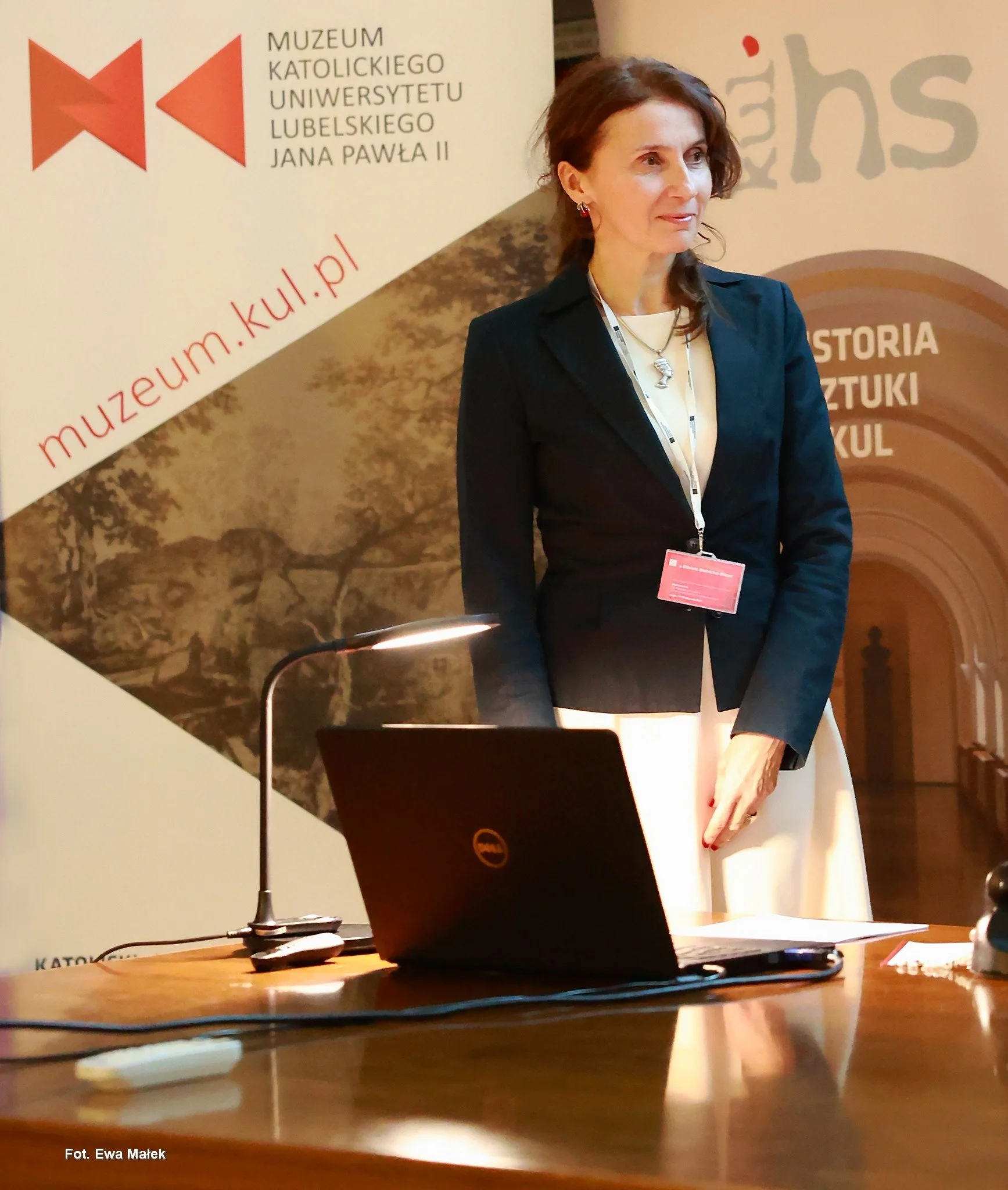
Elżbieta Błotnicka-Mazur, PhD, is Assistant Professor at the Department of Art History, Institute of Arts Studies, The John Paul II Catholic University of Lublin (Poland) and director of the Museum of the John Paul II Catholic University of Lublin.
Her research interests include contemporary museology as well as 20th-century art and architecture, with a particular focus on sculpture in public space and phenomena at the intersection of sculpture and other artistic disciplines in 1960s Poland. She is the author of the monographs Projekty architektoniczne Bohdana Kelles-Krauzego w zasobie Archiwum Państwowego w Lublinie i innych zbiorach archiwalnych [Architectural Projects by Bohdan Kelles-Krauze in the Holdings of the State Archives in Lublin and Other Archival Collections] (Lublin 2012) and Między profesją i pasją. Życie i twórczość Bohdana Kelles-Krauzego, zapomnianego architekta i malarza [Between Profession and Passion: The Life and Work of Bohdan Kelles-Krauze, a Forgotten Architect and Painter from Lublin] (Lublin 2010), as well as numerous articles, book chapters, and pieces of art criticism.
She is currently pursuing a project focused on selected aspects of the art of Adam Marczyński (1908-1985), associated with the Kraków Group of artists, with particular emphasis on his expansion of the medium of painting and on the concepts of interactivity and entropy
A member of Stowarzyszenie Historyków Sztuki [Association of Art Historians] – board member of the Lublin Branch.
https://orcid.org/0000-0002-5653-9481
https://repozytorium.kul.pl/browse/author?value=B%C5%82otnicka-Mazur,%20El%C5%BCbieta&bbm.return=1
Ivan Capeller
Ivan Capeller is Associate Professor at the School of Communications of the Federal University of Rio de Janeiro, Brasil (ECO/UFRJ). He is a production sound mixer for cinema and television and has written and published dozens of articles and reviews on the theory of cinema and sound studies, as well as the book O cinema e seu duplo, por uma semiótica dos dispositivos audiovisuais (2022).
Angelika Chęć
The John Paul II Catholic University of Lublin, Poland
Sayantan Dasgupta
Sayantan Dasgupta, PhD, specializes in Irish literature and existential semiotics. He defended his PhD from the University of Helsinki with his dissertation ‘The value of the name' : An Existential Semiotic Exploration of the Titles in James Joyce's 𝘋𝘶𝘣𝘭𝘪𝘯𝘦𝘳𝘴.
His specific areas of interest are Irish studies (literature, culture, history, politics, etc.), semiotics, Lacanian psychoanalysis, etc. He has published books and articles in Bengali, Finnish, and English. Some of his published works include: The Plane of Dasein: Existential Semiotics and the Problem of the Medium (in Transcending Signs: Essays in Existential Semiotics, De Gruyter Mouton, 2023), Sartrean Analysis of Emotion through Existential Semiotics (in Open Semiotics, Volume 1, L´Harmattan, Paris, 2023), Constructed SOI – yritys käyttää tarastilaista eksistentiaalista semiotiikkaa James Joycen Dublinersissa (in Synteesi Journal, Suomen semioottinen seura, Helsinki, 2023), The Mothers of Ireland: A Thematic Study of Motherhood in Irish Literature (Avenel Press, Kolkata, 2025), বাংলা ও আইরিশ সাহিত্যে অনুবাদের পারস্পরিকতা: অভিজ্ঞতা ও বিশ্লেষণ (The Reciprocity of Translation in Bengali and Irish Literature: Experience and Analysis, Onnyolekho, Kolkata, 2025), অলোকরঞ্জন দাশগুপ্তর গ্যোয়েটে: জার্মান থেকে বাংলা ভাষায় অনুবাদের সৃজনশীলতা (Alokranjan Dasgupta's Goethe: The Creativity of Translation from German to Bengali, Onnyolekho, Kolkata, 2026). He worked as an assistant editor for the anthology Transcending Signs: Essays in Existential Semiotics, (De Gruyter Mouton, 2023). He is a member of the Semiotic Society of Finland and Academy of Cultural Heritages, Greece-Finland.

Noha Essam
Assoc. Prof. Dr. Noha Essam Khamis is a thought Leader in Higher Education, Multipotentialite Strategic Foresight Consultant, Sustainability Expert, Research & Innovation Lead and Ethnographic Researcher. She serves as an Associate Professor of Interior Architecture &Interdisciplinary Design with 15+ years in Academia and 20+ years of professional practices. She is a Global Award-Winning Design Academic & A Futurist. Dr. Noha is the Cairo chapter founder of Speculative Futures, CA, US, A prestigious board member of AJMIRI/US. A Global Consultant & Advocate of Sustainability at Ministry of planning and economic development. A Fellowship Researcher at University of Applied Sciences and Arts Northwestern Switzerland & an Associate Researcher in the MQ program in collaboration with the Ministry of the Arts, Culture, the Civil Service and Sport- BMKÖDS/Vienna.
She is also an Environmental Psychology consultant & Chapter Director of GSAHW-UK. She received the leadership accolade of WDO for her excellence in the design driven foresight context that work in alignment with the UNDP. She has an extensive expertise in strategic future-proof curriculum development, instructional design and foresight research & innovation across higher education institutions in the Middle East, Gulf Region and Europe. She has served as an educational consultant and an external reviewer in the framework of education quality enhancement. Dr. Noha’s methodology revolves around integrating competency-based education, trans-disciplinary design, and experiential learning aligned with global workforce needs and civic impact. Her PhD thesis was shortlisted for the Best Ph.D. Interdisciplinary Thesis among Middle East universities. She has many international publications in interdisciplinary studies. Her crossover of passions, as well as her methodology, informs her work and creates brilliant and inspiring end results. She positively influences younger generations of designers through her work and researches. Her fusion of experiencing multidisciplinary was a process of unravelling of potentials and giving free play to her creative mind while considering the practical human experience that are at the core of her approach.
Elżbieta Chrzanowska-Kluczewska
Prof. dr hab. Elżbieta Chrzanowska-Kulczewska is a linguist, an honorary professor ordinarius (emerita since 2023), affiliated with the Institute of English Studies at the Jagiellonian University in Krakow, Poland.
Her main areas of interest cover literary semantics, stylistics, poetics, philosophy of language and artistic semiotics, on which subjects she has published extensively in acknowledged periodicals and collective volumes in Poland and abroad. Her monographs include Language-Games: Pro and Against (Kraków: Universitas, 2004) and Much More than Metaphor. Master Tropes of Artistic Language and Imagination (Frankfurt am Main: Peter Lang, 2013); she also co-edited collected monographs, inter alia In Search of (Non)Sense (with G. Szpila, Newcastle u. Tyne: Cambridge Scholars Publishing, 2009) and Language – Literature – the Arts: A Cognitive-Semiotic Interface (with O. Vorobyova, Frankfurt: Peter Lang, 2017). Honoured by her colleagues and collaborators with the volume: Text-Image-Music: Crossing the Borders. Intermedial Conversations on the Poetics of Verbal, Visual and Musical Texts (ed. by A. Pawelec, A. Shaw and G. Szpila, Berlin: Peter Lang. 2021).
A member of IALS (International Association of Literary Semantics), MLA (The Modern Language Association of America), IASS/AIS (International Association for Semiotic Studies), ATINER (Athens Institute for Education and Research), PTJ (Polish Linguistic Society, honorary member), the Neophilological and Linguistic Committees of the Polish Academy of Sciences in Krakow. A co-editor (with W. Witalisz) of the Peter Lang series Text-Meaning-Context. Cracow Studies in English Language, Literature and Culture.
ORCID: 0000-0002-0908-1711
Despina Gialatzi
Despina Gialatzi is a PhD candidate in European Historyatthe School of Early Childhood Education, in the Faculty of Education at the Aristotle University of Thessaloniki (AUT), Greece. She graduated from the School of French Language and Literature at AUT, where her PhD thesis was titled Historical and intersemiotic transformations in the work of Apuleius (124–170) and Jean de La Fontaine (1621–1695) and her Master’s was in French Literature and Interculturality, specialising in the comparative relationships between literature and the fine arts (her MA thesis title was Plume, pinceau où ciseau? Correspondances interartistiques du mythe de Psyché, 2013). She also has a Master’s in Semiotics, Culture, and Communication from AUT, specialising in semiotic narratology (her thesis title was An analysis of Perrault’s Le Maître Chat où Le Chat Botté illustrated by Doré,2021). She has also attended the Summer School of the Laboratory of Semiotics (SemioLab, AUT) in 2017, 2018, 2019, 2021 and 2023. She is a member of the Hellenic Semiotic Society, the Hellenic Folklore Society, the Hellenic Applied Linguistics Society, the Hellenic Translation Society, and the Association Internationale de Sémiotique / International Association for Semiotic Studies.
https://orcid.org/0009-0005-7085-7776
Clovis Salgado Gontijo
Prof. Clovis Salgado Gontijo (The Jesuit Faculty of Philosophy and Theology, Brazil), after completing his undergraduate studies (Faculdade Santa Marcelina) and a Master’s degree (Texas Christian University) in Music, shifted to Philosophy in order to devote himself to the field of Aesthetics. He earned a Bachelor’s degree in Philosophy from the Faculdade Jesuíta de Filosofia e Teologia (FAJE) and, with the support of the Chilean agency National Commission for Scientific and Technological Research (CONICYT), obtained a PhD in Philosophy with a specialisation in Aesthetics and the Theory of Art from the University of Chile, under the supervision of Andrés Claro.
From February 2016 to March 2025, he served as professor and researcher at the permanent faculty of the Graduate Program in Philosophy at FAJE, where he co-ordinated the research group “Mysticism and Aesthetics”. He is a member of the Susanne K. Langer Circle, an international group created in 2020 for the study and dissemination of the thoughts of the American philosopher Susanne K. Langer. As a fellow of the Fundação de Amparo à Pesquisa do Estado de Minas Gerais (FAPEMIG), he carried out, from September 2024 to May 2025, a postdoctoral research stay at the University of Salerno, under the supervision of Enrica Lisciani-Petrini and Daniela Calabrò. In November 2025, he was visiting professor at the University of Wrocław, at the invitation of Mariusz Turowski.
He is currently a collaborating researcher and postdoctoral fellow in the Department of Philosophy at the Federal University of ABC (UFABC), under the supervision of Fernando Costa Mattos, and a professor at the Seminário Provincial Sagrado Coração de Jesus in Diamantina.
He is the author of Ressonâncias noturnas: do indizível ao inefável (Loyola, 2017) and the translator of A música e o inefável (Perspectiva, 2018) by Vladimir Jankélévitch; Em algum lugar do inacabado (Perspectiva, 2021) by Jankélévitch and Béatrice Berlowitz; and Problemas da Arte (Quixote, 2026) by Susanne K. Langer. He has published extensively on Jankélévitch’s thoughts, including the production of the podcast 40 dias com Vladimir Jankélévitch (Spotify), which explores the philosopher’s contributions to the conception and lived experience of a non-religious spirituality. In addition to his academic work – focused primarily on the philosophy of music, nocturnal poetics, the theme of ineffability, and the intersections between philosophy and spirituality – he also seeks to apply his knowledge in artistic and cultural projects addressed to a broader public.
Eduardo Grillo
Eduardo Grillo is an independent researcher in semiotics who graduated in Semiotics and Symbolic Communication from the University of Siena (Italy). He has taught the semiotics of art at the Academies of Fine Arts in Naples and Bologna, and the philosophy of language and semiotics at the University of Perugia and LUMSA, in Rome and Palermo. His research focuses on media trends and products, including their relationship with digital technologies, as well as the relationship between semiotics and aesthetics. He is currently working on two volumes: one on the figure of the Lector Excerpens in relation to the contemporary media landscape, the second on the development of aesthetological approaches in European semiotics. Some of his works include Il compromesso dello sguardo. Cornelis Gijsbrechts e le ossessioni barocche [The Compromise of the Gaze. Cornelis Gijsbrechts and Baroque Obsessions], Perugia, Morlacchi Editore, 2016; Post-War Dream(s). L’informale e l’utopia della comunicazione [Post-War Dream(s). Informal Art and the Utopia of Communication], Perugia, Morlacchi Editore, 2016; and Semiotica. Storia, modelli, contesti [Semiotics. History, Models, Contexts], Rome, Carocci, 2014(with Andrea Bernardelli). He is the author of numerous chapters and articles published in the main semiotic academic journals such as “Garroni, the late Peirce and the Issue of Creativity” (with G.D. Guagnano) in Semiotica. Journal of the International Association for Semiotic Studies / Revue de l'Association Internationale de Sémiotique (2020, pp. 165–184); “Divenire zombi. Da Haiti a Romero, tra automodelli e traduzioni” [Becoming a zombie. From Haiti to Romero, between Self-models and Translations] (2025, pp. 56–74) and “Testi fatti a pezzi. Il culto mediale come ars excerpendi” [Texts in pieces. The media cult as ars excerpendi] (2020, pp. 16–32) in Ocula. Occhio semiotico sui media, and “Art as a Language Facing Reality” in Studia Semiotyczne 38(1) (2024, pp. 11–21, 2024). He was co-editor of thematic issues of Occhio semiotico sui media (2020, 2025) and Castelli di Yale (2024).
Bujar Hoxha
Bujar Hoxha, PhD, is a full professor, currently teaching “Introduction to Communication”, “Theory of Communication”, “Semiotics of Mass Communication” and “Intercultural Studies” at the South-East European University, Tetovo and Skopje, North Macedonia, in the Faculty of Languages, Cultures and Communication. His recent research activities include the following: a chapter in “The Semiosis of Creation, Between Nature, Body and Arts” entitled ‘The Poetics of the Pitch: Using Umberto Eco to Explain Technological Investments”, co-authored with John Tennderick Rowe, Universidad de Rosario, Bogota, 2025 (edited by Jorge Eduardo Uruena Lopez, Jamin Pelkey and Ludmila Lackova- Bennet), as well as the following papers: “An Epistemological Way of Exemplifying Artistic Realities From a “transformational” to a “transcendental” sign” in Studia Semiotyczne, University of Warsaw, Warsaw, Poland, 2024; “Umberto Eco’s Writing Labyrinth: from the Code’s Theory to the Interpretation Process” in Humanities Bulletin, issued by the London Academic Publishing, London, UK, 2025; “Semiotics of Precision and Imprecision”, in Semiotica. Journal of the International Association of Semiotics, Walter de Gruyter, Berlin and Boston, 2016; as well as the chapter “Fiction and Reality in Eco’s Words” in Umberto Eco in His Own Words, edited by Torkild Tefellsen, and Bent Sonensten, Walter de Gruyter, Berlin and Boston, Germany and USA, 2017. He is the author of the book Umberto Eco’s Semiotics: Theory, Methodology and Poetics, Cambridge Scholars Publishing, Newcastle upon Tyne, UK, 2022.
Anthony Jappy
University of Perpignan-Via Domitia, France
Kinga Krzymowska-Szacoń
Kinga Krzymowska-Szacoń is Assistant Professor at the Institute of Arts Studies, The John Paul II Catholic University of Lublin (Poland) and a member of the Editorial Board of Roczniki Humanistyczne [Annals of Arts]. She conducts research on 20th century composers, with a focus on Polish émigré artists and the aesthetic context of their work. Her output has been presented at various international conferences and publications (Voice from the Wound: Selected Post-War Works by Szymon Laks as a Composer’s Path to Resilience; W świetle wiecznym i niegasnącym. Wizja nieba we francuskiej muzyce organowej piewszej połowy XX wieku [In the Eternal and Unfading Light: The Vision of Heaven in French Organ Music of the First Half of the 20th Century]; W ramionach Matki, pod płaszczem Królowej. Wybrane aspekty kultu maryjnego w twórczości kompozytorów polskich w latach 1956–2018 [In the arms of the Mother, under the Queen's protection. Selected aspects of the Marian cult in the works of Polish composers in the years 1956–2018]; Art Attractive for the Masses or Fetters of the Artistic Freedom? Elements of Folklore in the Music of Polish Socialist Realism et al.). In addition to her academic work, Kinga Krzymowska-Szacoń is active in the Association of Polish Artists–Musicians.
Katarzyna Machtyl
Dr Katarzyna Machtyl is a cultural semiotician, a Doctor of Philosophy in Cultural Studies, and Assistant Professor in the Department of Cultural Semiotics of the Cultural Studies Institute at the Adam Mickiewicz University in Poznań, Poland. Her research interests include general semiotics and the possibilities of the semiotic theory’s integration, cultural semiotics, biosemiotics, existential semiotics, nature-culture relationships in the view of semiotics, as well as its conceptualisations in contemporary anthropology (especially Bruno Latour’s and Tim Ingold’s). She is chairperson of the Polish Society for Cultural Studies’ Poznań branch, and a member of the International Association for Semiotic Studies, the Nordic Association for Semiotic Studies, the International Society for Intermedial Studies, the Polish Semiotic Society and the Polish Society for Cultural Studies. She is the author of research papers and co-editor of collected volumes on visual semiotics, history and theory of semiotics, biosemiotics, and existential semiotics. Her most recent book is “Semiotyki obrazu. Reprezentacje i przedmioty” [“Semiotics of an Image. Representations and Objects”] (2017).
https://www.researchgate.net/profile/Katarzyna-Machtyl-2?ev=hdr_xprf
Kobus Marais
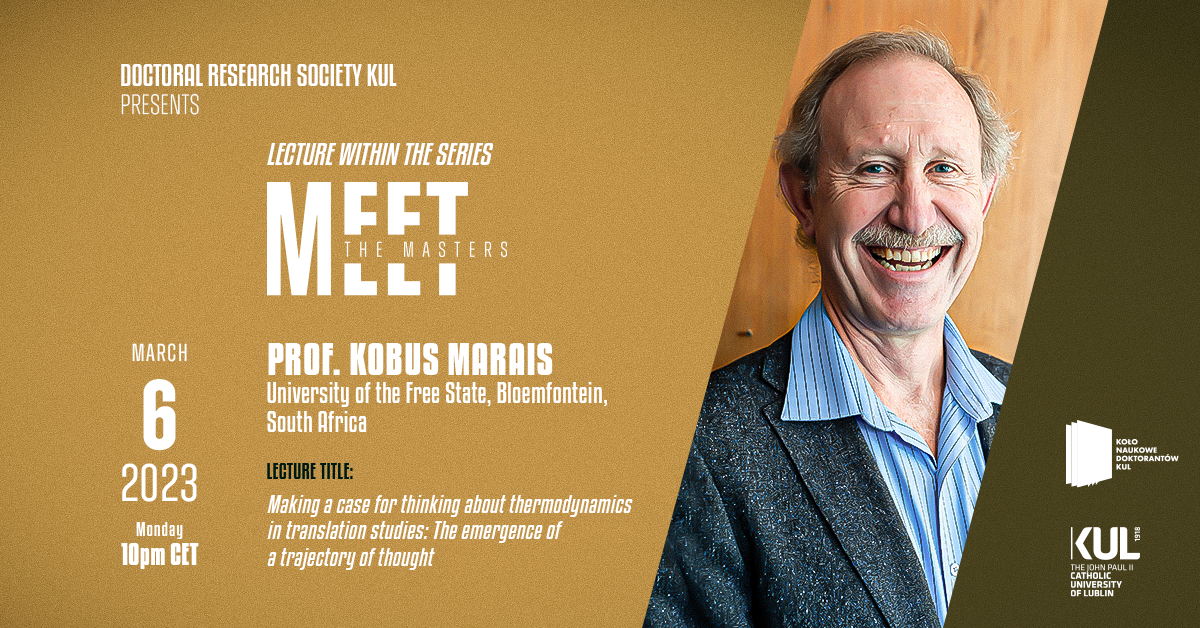
Kobus Marais is Professor of Translation Studies at the University of the Free State, Bloemfontein. He has published three monographs, namely, Translation Theory and Development Studies: A Complexity Theory Approach (2014), A (Bio)Semiotic Theory of Translation: The Emergence of Social-Cultural Reality (2018) and Trajectories of Translation: The Thermodynamics of Semiosis (2023).
Irmak Mertens
Irmak Mertens is a postdoctoral research fellow at the University of Tartu (Estonia), and an honorary research fellow at the University of Exeter (UK). She holds two doctoral degrees, one in Translation Studies from KU Leuven (Belgium), and another in Semiotics and Cultural Studies from the University of Tartu. Since 2022 she has taught courses such as “Museums, Translation, and Semiotics” and “Translation Studies” at both institutions, and currently co-teaches “National and Cultural Image Building through Translation” at the University of Tartu. Her research focuses on museum translation, imagology, transmediality, and the sociology of translation, with a growing emphasis on city translation. She has co-organised panels and seminars on this topic in Paris, New Brunswick, and Tartu, and is the co-founder and the co-ordinator of the City Translation Network. In parallel with her academic endeavours, she is also a curator as well as a style editor for numerous academic publications in the field of Translation Studies.
Her most important publications are “Towards a Methodology for City Translation Research” (with Luc van Doorslaer) in Open Semiotics Volume 5, edited by Amir Biglari. Paris: L'Harmattan (forthcoming 2026); “Translation as Metonymic Cultural Transmission: The Case of the Istanbul Archaeology Museums” (with Luc van Doorslaer) in Translating Modernity: (Trans)formations of a Concept, edited by Salah Basalamah and Abdel-Wahab Khalifa. London: Palgrave Macmillan (forthcoming 2026); “‘Poetically Well-Built Museums’: Transmedial Storytelling and World-Building in The Museum of Innocence” in Devised Truths and the Transmedial Construction of Worlds, edited by Elin Sütiste and Vasso Giannakopoulou. London: Palgrave Macmillan (2026); “Selecting and Publishing Dutch Literature in Turkey: The Case of Arnon Grunberg’s Graphic Novel Van Istanbul naar Baghdad (From Istanbul to Baghdad) in Turkish” in Literary Translation Lifecycles: The Vital Networks Behind the Circulation of Dutch Literature, edited by Jack McMartin and Paola Gentile. London: Routledge (2026); “Museum Translation: A Combined Translation Studies and Semiotics Perspective” (with Luc van Doorslaer) in Tradition and Innovation in Translation Studies Research XII: Bridging Cultures and Communities through Translation Studies, edited by Eva Verebová, Lenka Žitňanská, Andrej Birčák, and Andrej Zahorák, 9–32, Nitra Press: Constantine the Philosopher University in Nitra (2024), and (with Sophie Decroupet) “Conceptualizing Museum Translation: Cultural Translation, Interlingual Processes, and Other Perspectives” in the special issue Museums as Spaces of Cultural Translation and Transfer, Babel 70 (5): 593–614 (2024).
Ivana Petković Lozo
Dr. Ivana Petković Lozo is a musicologist whose research focuses on European fin-de-siècle music, the interplay between music, literature, and the visual arts, as well as the philosophical and aesthetic foundations of musical experience. She earned her PhD from the Faculty of Music at the University of Arts in Belgrade, where she taught for fifteen years as an Assistant Professor of Musicology. She has also contributed to the Interdisciplinary Studies programme at the University of Arts in Belgrade.
She has published widely in national and international journals, monographs, and edited volumes. She is the author of The Late Oeuvre of Claude Debussy: “Truths” about the French Myth (2011) and co-author of Stevan Stojanović Mokranjac in the Writings of “Others” (2014).
Her teaching portfolio spans undergraduate and graduate courses on Western music history, fin-de-siècle Serbian music, aesthetics, contemporary musical poetics, synesthesia, and interdisciplinary approaches to music. She initiated the master’s programme Artistic Synesthesia: Theory and Practice at the University of Arts and has supervised numerous student research projects, master’s theses, doctoral artistic projects, and cross-disciplinary studies. She has also participated in international research initiatives at the Institut für Musikwissenschaft, University of Vienna, and through the Erasmus+ program at the Lithuanian Academy of Music and Theatre.
As a project leader and co-investigator, she has demonstrated strong expertise in grant writing, research management, and interdisciplinary coordination, contributing to projects supported by academic institutions, government agencies, international foundations, and university research councils.
She is currently a Visiting Scholar in the Department of Music at the University of California, Riverside, USA, and an active member of the International Musicological Society (IMS), the American Musicological Society (AMS), the Modernist Studies Association (MSA), the International Association for Semiotic Studies (IASS), The Society for Electro-Acoustic Music in the United States (SEAMUS), the College Music Society (CMS), the Serbian Musicological Society (SMS), and the Music Writers’ Chapter of the Composers’ Association of Serbia.
Ruggero Ragonese
Ruggero Ragonese is Associate Professor of Semiotics at the University of Modena and Reggio Emilia (Italy). He graduated in Semiotics under the supervision of Umberto Eco at the University of Bologna, with a thesis on the Altare della Patria in Rome. He earned his PhD at the University of Siena, where he worked with Paolo Manetti and Omar Calabrese. His doctoral research focused on the study of the figures and bodies of saints between the Middle Ages and Modernity, exploring their transformations across visual, textual, and cultural representations. He has worked at Université Lille 3 and at the Università della Svizzera Italiana (Mendrisio campus), where he served as Maître-assistant in Styles and Techniques of Cinema. He has also taught at the University of Milan, the Polytechnic University of Milan, IULM University, and the University of Bologna.
He is currently the Principal Researcher of a research project funded by the Italian Ministry of University and Research, focusing on the relationship between the urban space of Reggio Emilia and on-line multimedia descriptions and commentary. His research interests include semiotic theory, visual and cultural analysis, urban semiotics, and the processes of meaning-making across media and historical contexts. Through his scholarship and teaching he promotes interdisciplinary dialogue and critical inquiry into the ways signs, images, and discourses shape cultural experience.
Wojciech Sternak
Wojciech Sternak (PhD, with a postdoctoral degree) is a theorist and visual artist. He works at the University of Warsaw as an associate professor. The main fields of his academic interests include photography (theory, practice, art-based research), visual arts, visual communication and the contemporary aesthetics of visuality. Wojciech Sternak is also a renowned photographer, and has presented his fine art in numerous individual and collective exhibitions in Poland and throughout Europe.
Through his theoretical and artistic research he examines the medium of photography as a tool for (re)creating reality, bending the messages and (post)modern ways of representation and reconfiguration of cultural-built meaning. He has also been a member of board of, amongst others, the Polish Culture-Studies Society, the Photography Scientific Society and the Polish Union of Art Photographers.
He has lectured as a visiting professor at many European Universities (e.g. La Sapienza in Rome, University of Turin, University in Bari Aldo Moro, CEO San Pablo in Madrid, University of Zaragoza and many others). He also works as a member of the jury in photography and/or visual art contests.

Carlos Jose Villar-Taboada
Prof. Carlos Jose Villar-Taboada is a musicologist who has completed short research stays at the Sorbonne and IRCAM (Paris, 1998), and at Columbia University (New York, 1999). A Tenured Associate Professor (accredited to Full), he has chaired the Musicology PhD Program at the University of Valladolid (Spain) since 2019.
He has supervised over 35 master’s theses and 13 PhD dissertations on key figures and events in contemporary Spanish music. After lecturing at dozens of conferences, he is currently in charge of the national research project Topics, Dialogues, and Identities in Spanish Music: 18th to 20th Centuries, and organises international events and groups on music analysis, Topic Theory and musical hermeneutics, such as the Erasmus+ KA131 BIP Analytical and Hermeneutical Approaches to Music (Valladolid, March 2026).
His research production focuses on the analysis of Hispanic music – particularly Spanish and Cuban – from the 20th century onwards. Methodologically, it draws on the Pitch-Class Set Theory, twelve-tone analysis, and semiotic and hermeneutic approaches, as may be found in ORCID (ORCID-Link), Dialnet (Dialnet-link), and the UVa’s Institutional Repository (institutional personal web).
His most recent publications are “Rodolfo Halffter’s Capricho, op. 40 (1978), for solo violin: topics, meanings and twelve-tone technique”, Nova Contemporary Music Journal [ISSN: 2795–4803](CESEM, Universidade Nova de Lisboa, coord. Isabel Pires), 4/1; “Listening to Today’s Music (I)”: 148–160 (2025): https://fabricadesites.fcsh.unl.pt/ncmm/listening-to-todays-music/; “In the Maze of the Night: Rodolfo Halffter’s Dialogues with History in Piano Works around 1970”, in Musical Analysis. Historia – Theoria – Praxis. Volume VII (Anna Granat-Janki, ed.), Wroclaw (Poland): The Karol Lipinski Academy of Music, pp. 97–118 (2025): https://www.dbc.wroc.pl/dlibra/doccontent?id=141694; “Modelos divergentes en el repertorio bandístico gallego actual: A pedra da liberdade (2002), de Groba, y Na Galiza (2011), de Pereiro” in Vientos en el horizonte. Prácticas, discursos y proyección de las bandas de música en el mundo ibérico (Isabel Mª. Ayala Herrera y Virginia Sánchez López, eds.), Madrid: Dykinson, pp. 557–585 (2025); “Cantos modernistas según Joaquín Rodrigo: Dos poemas de Juan Ramón Jiménez” in Cuplé y canción española: escenarios de representación (Tatiana Aráez, Enrique Encabo e Inmaculada Matía, eds.), Madrid: Dykinson, pp. 123–135 (2024): https://doi.org/10.14679/3275; “El intérprete como creador de canon: tipos históricos y tópicos idiomáticos en seis sonatinas para Gabriel Estarellas” in Musicología y análisis musical: juego de espejos (Diego García-Peinazo y Julio Ogas Jofre, eds.), Oviedo: Universidad de Oviedo-Sociedad Española de Musicología, pp. 69–84 (2024); “Capriccio para flauta solo, de Gerhard: entre tradición y dodecafonismo” in Propuestas pedagógicas e interdisciplinares sobre el análisis y la teoría musical (María Elena Cuenca Rodríguez, Miguel Ángel Ríos Muñoz, Francisco Ruiz Montes y John A. Griffithts, coords.), Sevilla: Wanceulen, pp. 375–386 (2024); “Postmodernismo e intertextualidad: la fantasía como tópico en la música de José Luis Turina” in Quodlibet. Revista de especialización musical, 80 (2023/2), pp. 121–155 (2023): https://doi.org/10.37536/quodlibet.2023.80.2454; “Música y significado: caminos hacia la hermenéutica musical” in Quodlibet. Revista de especialización musical 80 (2023/2), pp. 4–19 (2023): https://doi.org/10.37536/quodlibet.2023.80.2745; “Un “espíritu español” en México: historia y dodecafonismo en Rodolfo Halffter durante los años cincuenta” in Músicas iberoamericanas: caminos, redes, circuitos (Javier Marín-López, Montserrat Capelán y Paulo A. Castagna, eds.), Madrid-Frankfort am Mein: Iberoamericana Vervuert, pp. 459–484 (2023): https://doi.org/10.31819/9783968695600_019; “Tres hojas de álbum, op. 22 (1953): Rodolfo Halffter y la huella de Schoenberg” in Neuma. Revista de música y docencia musical (Universidad de Talca, Chile), Vol. 16/2 (2023/2), pp. 53–85 (2023): https://doi.org/10.4067/S0719-53892023000200053; “Gestos de postmodernismo estético en José Luis Turina: Pentimento, del lienzo a la orquesta” in Poéticas compartidas: convergencias artísticas en la música de los siglos XX y XXI. (Belén Pérez Castillo y Ruth Piquer Sanclemente, eds.), Granada: Comares, pp. 273–299 (2023); he is also co-editor (with Carme Tubío Barreira) of the book Cancións galegas do Festival de Pontevedra: volume I, Baiona (Pontevedra): Dos Acordes (2023).
Yanina Yukhymuk
Independent scholar, Ukraine

Jimena Bigá
Jimena Bigá is a fully funded PhD researcher in Indigenous Studies at the University of Helsinki, supported by the Kone Foundation. She is an Associated Researcher at the Centre of Excellence in Multibeing Justice in Indigenous Societies and currently a Marie Skłodowska-Curie Fellow in the EDGES project (Entangling Indigenous Knowledges in Universities), funded by the European Commission. She holds a Master’s degree in Archaeology and Cultural Heritage, specialising in Indigenous and decolonising archaeologies, with an academic background in semiotics, Latin American studies, and sociocultural anthropology. Her community-based research is carried out in close collaboration with the Tuxá Indigenous people of Rodelas, in Northeastern Brazil, particularly with Tuxá youth. Her collaborative work centres on multispecies heritage, encompassing Indigenous-led land-based pedagogies, Indigenous methodologies, body–territory approaches, more-than-human ethics, and ethico-onto-epistemological pluralism and justice. She further explores questions related to time and multi-temporalities, and the epistemic multimodality in the Brazilian Northeast.
Apart from academia, she collaborates on archaeological repatriation, territorial demarcation, and the revitalisation of the Dzubukuá language. In 2024, she was a visiting researcher in Argentina and Bolivia. Her recent publications include “The Toré and its Elements in Tuxá Indigenous Context: Translating Inner World through Performative ‘Art’ in Brazilian Northeast” and “Land-Based Education and Tuxá Cultural Resilience in the Opará River, Brazil”.
Karin Boklund-Lagopoulou
Karin Boklund-Lagopoulou is Professor Emeritus of English Literature in the School of English of the Aristotle University of Thessaloniki, Greece, where she taught medieval literature and literary theory. Her doctorate in Comparative Literature is from the University of Colorado, Boulder. She was for many years secretary of the Hellenic Semiotic Society and is currently coordinating member of the Collegium of the IASS/AIS. Her publications in Greek, European and American journals and collective volumes include papers on literature, narrative analysis, literary theory and popular culture and a book on medieval lyric poetry; she also co-edited (together with Mark Gottdiener and Alexandros Lagopoulos) the anthology Semiotics for Sage Benchmarks in Social Research Methods and has done language editing for English translations of work in semiotics. Her main research interests are narrative theory and textual analysis; her recent work in visual semiotics has its source in a class in Narratology Across the Media that she teaches with her husband for the postgraduate programme in Semiotics, Culture and Communication at Aristotle University. She frequently collaborates with her husband, most recently in their work on the collective volume Semiotics of Images: The Analysis of Pictorial Texts.
Miloud Boukhenoune
Dr. Miloud Boukhenoune is Associate Professor of Media and Communication Sciences at the Department of Media and Communication Sciences, Faculty of Humanities, University of Oran 1 (Algeria) and the head of the research group “Semiotics, Intercultural Communication and New Medias”, affiliated to the Sigma Laboratory at the University of Oran 1. He earned his PhD in the Humanities and Communication from the University of Algiers 3. His main interest areas are the semiotics of communication, the semiotics of culture, the semiotics of tourism, intercultural communication, and new media, as well as the relationship between intercultural communication and cultural adaptation. He has published papers on the symbolism of monuments in the construction of local identities, as well as on social media and everyday life. Currently, he is working on semiotic approaches dealing with questions of art and cultural identity in everyday life.
Paulo Chagas
University of California, Riverside, USA
Samaneh Eshraghi Ivari
Samaneh Eshraghi Ivari (b. 1984) is a semiotic researcher and architect specialising in the intersection of culture, architecture and human perception. Her PhD thesis, entitled Culture Sustainability and Architecture Semiotics, examines how cultural signs connect architectural symbols with human understanding. With teaching experience at the Near East University (Nicosia, Northern Cyprus) and presentations at international conferences, her work focuses on architectural semiotics, cultural heritage, and socio-political transformations in Iran. Samaneh is committed to exploring how semiotics shapes urban identity and cultural heritage in dynamic contexts. She received the Association Internationale de Sémiotique / International Association for Semiotic Studies scholarships for the 16th World Congress of Semiotics (Warsaw 2024).
Anna Głowa
The John Paul II Catholic University of Lublin, Poland
Małgorzata Grajter
Małgorzata Grajter is Assistant Professor and Head of Department of Music Theory at the Grażyna and Kiejstut Bacewicz University of Music in Łódź, Poland. She has also collaborated as a guest researcher with the Faculty of Philology of the University of Łódź. Her research interests are centred around the music of Ludwig van Beethoven, the relationships between word and music, translation studies, Portuguese music, and popular music culture. She is the author of the books Das Wort-Ton-Verhältnis im Werk von Ludwig van Beethoven (2019) and Applying Translation Theory to Musicological Research (2024).
Agata Handley
Agata Handley (PhD) is Assistant Professor in the Department of British Literature and Culture, the University of Łódź. Her main areas of academic interest are contemporary British poetry and transmedial studies. Her current research includes ekphrasis in Anglophone literature and visual art. She is the author of Constructing Identity in the Poetry of Tony Harrison (2021), and Editor-in-Chief of Text Matters: A Journal of Literature, Theory and Culture. Currently, she is Visiting Fellow at the Institute of Languages, Cultures and Societies at the University of London.
Her recent publications include “‘From Flesh into Marble’: Translating Grief Between Media in Tony Harrison's Film-Poem” in Translating Human Inner Life In and Between the Arts: A Semiotic Approach to the Emotions and the Process of Translation, Gamrat Małgorzata (ed.), Studies in Translation (series), Bloomsbury 2025, pp. 189–214; “Indispensable Rhythm: Scott Fitzgerald’s Poetic Entanglements” in The Bloomsbury Handbook to F. Scott Fitzgerald,Rattray Laura, Wagner-Martin Linda (eds.), Bloomsbury, 2025; “Reframing the Viewer’s Gaze. Ekphrastic Reconfigurations in Beyoncé and Jay Z’s APESHIT (2018),” in Music Video and Transcultural Imaginaries: Media – Aesthetics – Social Utopia, Dreckmann Kathrin, Jost Christofer, Schramm Bastian (eds.), Populäre Kultur und Musik (series), vol. 44, Waxmann 2025, pp.283–302; and Aesthetic Amalgams and Political Pursuits: Intertextuality in Music Videos, Dobrogoszcz Tomasz, Handley Agata, Fisiak Tomasz (eds.), New Approaches to Sound, Music, and Media (series), Bloomsbury 2024.
Jean-Marie Jacono
Aix-Marseille University, France
Dorota Jewdokimow
Prof. Dorota Jewdokimow is associate professor at the Adam Mickiewicz University in Poznań. She works at the Cultural Studies Institute (the Department of Cultural Semiotics), where her research focuses on Russian literature, philosophical, religious and social thoughts of the 19th and 20th centuries, and recently, primarily on anti-war Russian popular music and the semiotics of emotions. She is the author of the monographs: Człowiek przemieniony. Fiodor M. Dostojewski wobec tradycji Kościoła Wschodniego [Man Transformed: Fyodor M. Dostoyevsky and the Tradition of the Eastern Church] (Poznań 2009), and Na stycznej. Idea zjednoczenia Kościołów w rosyjskiej myśli filozoficzno-religijnej i społecznej [On the Tangent: The Idea of Church Unification in Russian Philosophical, Religious, and Social Thought] (Poznań 2017), and with Karolina Kizińska: Cultural Theory and History: Sign and Context (Poznań 2014).
Agnieszka Kuczyńska
Agnieszka Kuczyńska is Assistant Professor at the Institute of Art Studies of the John Paul II Catholic University of Lublin, Poland. Her research interests focus on nineteenth- and twentieth-century art with an emphasis on intermediality and semiotics. She has published on painted theatre curtains of the nineteenth century and allegories in academic art (Malowane kurtyny teatralne Henryka Siemiradzkiego [Henryk Siemiradzki’s painted theatre curtains], 2010). She is also interested in Polish art of the 1960s and 1970s, especially that of Zbigniew Makowski (Zbigniew Makowski. Wąski Dunaj nr 5, 2008; Dark Emotions. Translating Beckett into Visuality. The Case of Zbigniew Makowski, in Translating Human Inner Life In and Between the Arts, ed. Małgorzata Gamrat, Bloomsbury 2025, pp. 215–230).
Filipa Magalhães
Filipa Magalhães is Assistant Researcher at CESEM – Centro de Estudos em Música at Faculdade de Ciências Sociais e Humanas (NOVA FCSH). She holds a PhD in Musicology and a postgraduate degree in Historical Archivistics. Her research focuses on the preservation of music theatre works, combining musicology, archival science, and digital humanities. She coordinates the Contemporary Music Research Group at CESEM and Thematic Line 4 (Archives) at IN2PAST—Associate Laboratory for Research and Innovation in Heritage, Arts, Sustainability, and Territory.
Agnieszka Matysiak
Agnieszka Matysiak is Assistant Professor in the Department of Applied Linguistics at Maria Curie-Skłodowska University in Lublin (Poland), specialising in literary studies. She is the author of The Backstage as the Diegetic Space in the (Neo)Gothic Dramas (Lublin: Wydawnictwo KUL, 2010), and several articles on contemporary American drama,and is currently working on a book about (Neo)Baroque melancholy and has just finished a monograph entitled Preposterous Theatre: Jacobean Spectacle in Contemporary American Drama (Routledge, 2026–2027). She received her PhD in 2017.
Ricardo Nogueira de Castro Monteiro
Prof. Dr. Ricardo Nogueira de Castro Monteiro (b. 1966) serves as professor of Composition, Conducting and Semiotics at the Federal University of Cariri (UFCA) in Brazil, where he also conducts the university orchestra and is its resident composer. His professional activities include his academic career, various works as a composer, playwright and music director, and a consulting portfolio on applied semiotics including major brands such as Johnson & Johnson and Unilever, among others. He is a member of the “Semiotics of Cultural Heritage” research group led by Eero Tarasti, having his branch of the project supported from 2014 to 2016 by the São Paulo Research Foundation, and from 2023 to 2024 by the Ceará Foundation for the Support of Scientific and Technological Development. He presently directs a research group dedicated to the transcription and semiotic analysis of the still vigorous corpus of traditional musical dramas orally transmitted throughout centuries in the Brazilian Northeast. His main research areas include semiotics of music, syncretic performative texts, cultural heritage, ethnomusicology, song analysis and semiotics applied to marketing and communication.
Among his most important publications are: "The hidden meaning of the feast: Representations of gender, class and ethnic oppression in a performance of the Brazilian Guerreiro" (Studia Semiotyczne, v. 38, p. 81–108, 2026); "L’anéantissement des musulmans dans un auto-mystère traditionnel du folklore brésilien : la complexité du statut du vivant, entre le simulacre de la mort symbolique et les différentes gradations de survivance", in Le vivant comme effet de sens (Bordeaux: Presses Universitaires de Bordeaux, 2026, p. 123–136); "From identity to transcendence: A semiotic approach to the survival of the Carolingian cycle in the Brazilian cultural heritage", in Transcending Signs: Essays in Existential Semiotics (Berlin: De Gruyter Mouton, 2023, p. 501–520); and "The Epiphany feast in Brazil: A semiotic perspective to the analysis of a living liturgic drama tradition", in Music as Cultural Heritage and Novelty (Cham: Springer Nature, 2022, v. 24, p. 337–375).
Helena Pires
Helena Pires is Associate Professor at the Department of Communication Sciences, Institute of Social Sciences, University of Minho (Portugal), and a member of the Communication and Society Research Centre. She gained a PhD in Communication Sciences in the field of the Semiotics of Communication from the University of Minho in 2007. She has taught in the areas of advertising, semiotics, and communication and art at this same institution. For four years, until November 2019, she was the co-ordinator of the Advertising Group of SOPCOM – the Portuguese Society of Communication Sciences. She has published and developed research work in the field of visual and urban culture, namely on (urban) landscapes, and in particular on the landscape in contemporary art. She jointly co-ordinates Passeio – the Platform of Art and Urban Culture (a CECS/UMinho research and intervention project: https://www.passeio.pt/en/). Her research interests focus on urban art and culture, communication semiotics, art semiotics, and advertising.
Some of her main publications are the following: “Garden of Eden. Art and the artificiality of the natural”, Studia Semiotyczne, 38(1), pp. 129–149 (2025) DOI: 10.26333/sts.xxxviii1.08); “Plagiarism as a Form of Intersemiotic Translation: The New Forms of Implicit (Un)Boundaries in the Visual Contemporary Arts” (with Rui Sousa-Silva) in M. Gamrat (ed.), Translating Human Inner Life In and Between the Arts. A Semiotic Approach to the Emotions and the Process of Translation. Bloomsbury Publishing. (2025); “How Does Landscape (Re)Connect the Real and the Virtual? A Media Arts Case Study” in Gil Soeiro, R., Álvares, C., Freitas, M. & Bernardino, L (eds.), Entanglements in the Age of the Posthuman (pp. 164-182). Brill (2025); she is also co-editor (with Zara Pinto-Coelho, Luísa Magalhães) of the book Communicating Human and Non-Human Otherness – Urban Culture, Technology and Post-Humanism. Palgrave MacMillan (2024): https://doi.org/10.1007/978-3-031-73386-4
Evangelia Sakellari
Aristotle University of Thessaloniki, Greece
Leonid Tchertov
International Association for Semiotics of Space and Time, Germany
Mário Videira
Mário Videira is a pianist and Professor of Musical Aesthetics at the School of Communications and Arts of the University of São Paulo (ECA-USP, Brazil), where he also serves as Vice-Dean (2025-2029) and is affiliated with the Graduate Program in Music in the areas of Historical Musicology and Musical Aesthetics. He holds degrees in Music and Philosophy from the University of São Paulo (USP), a Master's degree in Musicology from São Paulo State University (UNESP), and a PhD in Philosophy from USP, with a research stay at the University of Tübingen (Germany) funded by DAAD/CNPq. In 2025 he completed a postdoctoral fellowship in Musicology at the Universidad de Oviedo (Spain), funded by the Fundación Carolina and the Grupo Tordesillas. He is the author of Romanticism and the Musically Beautiful (UNESP Press, 2006) and translator into Portuguese of Theodor W. Adorno's Berg: Master of the Smallest Link. His research focuses on musical aesthetics, semiotics and the philosophy of music. He maintains active international research partnerships with the Austrian Academy of Sciences (ÖAW) and the University of Lisbon (UL), and is a member of the International Musicological Society (IMS).
Ulrika Varankaitė
Ulrika Varankaitė is assistant professor at the Kaunas University of Technology in Lithuania. In 2020, she obtained her PhD degree in Art Research (Musicology); her thesis empirically investigated the extramusical associations evoked by listening to music mainly from the perspective of music psychology and semiotics. In 2015, Ulrika had her internship at the Cognitive Brain Research Unit (University of Helsinki, Finland) assisting in a project that involved EEG measurement and in 2018 her internship was at the Center for Music in the Brain (Aarhus University, Denmark) where she assisted in two different projects with fMRI and MEG data acquisition. Ulrika’s academic interests vary from film music and listening to music to music semiotics, music psychology and the cognitive neuroscience of music, considering and combining classical and new theories, studies, technologies. Her current research focuses on music-induced inspiration and self-transcendence. Amongst her most important publications are Aesthetic Empowerment Through Music (2019; co-authored with Prof. Elvira Brattico from the Center for Music in the Brain): https://journals.sagepub.com/doi/10.1177/1029864919850606 and Music, Listener and Extramusical Experience (2021): https://link.springer.com/chapter/10.1007/978-3-030-72507-5_5.
Katarzyna Ziemlewska
The John Paul II Catholic University of Lublin, Poland
Our activities
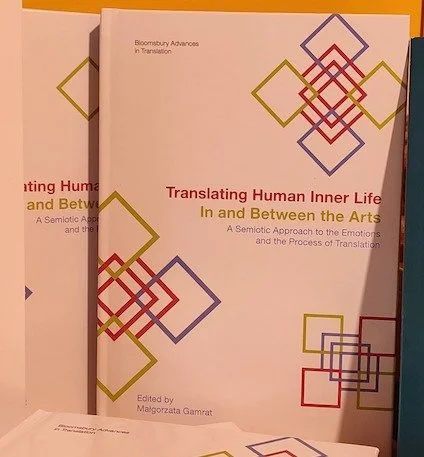
Recent Publications
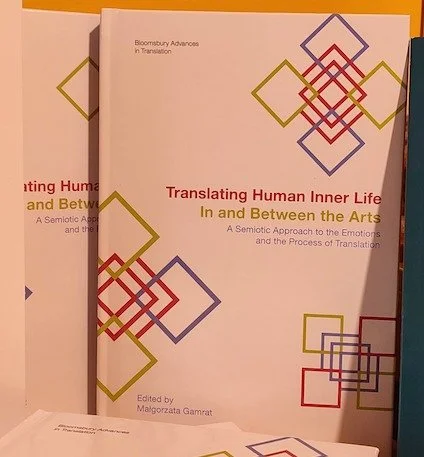
Translating Human Inner Life In and Between the Arts. A Semiotic Approach to the Emotions and the Process of Translation, ed. Małgorzata Gamrat, Bloomsbury 2025
Thematic issues of “Studia Semiotyczne” (guest editor Małgorzata Gamrat)
38(1) Semiotics, Arts, and Reality
38(2) Between semiotics, music and signification
Workshop II
Arts, Semiotics and Emotions/ Feelings / Sentiments / Inner Life, etc.
Emotions, feelings, sentiments, inner life – whatever we might call it – are crucial to human life and very important in the arts. (I use the term ‘emotions’ to cover all of these in order to shorten this description and the workshop questions). This is one of the most important elements of the arts which often manifests itself in the artist’s deep sensibilities. Over the centuries, artists have created dozens of means of encoding and decoding the emotions, as well as of stimulating emotions or, sometimes, influencing our behaviour. In semiotics, this is one of the important issues analysed, among others, by Peirce. The aim of this workshop is to search for an answer to the following questions: in which ways do the emotions function in the arts and how we can investigate them, and in which way(s) can we understand the connections between emotions and signs, codes and systems, and how can we find such elements in the arts?
The main questions are:
1. What do we understand as emotions from the perspectives of our fields of research?
2. How to identify signs, codes and systems connected to emotions in the various arts?
3. Which signs, codes and systems have been used by artists to present emotions over the centuries?
4. In which ways do artists encode emotions and in which way do receivers decode them?
5. In which way could semiotics help understand the emotions and the codes / signs connected to them?
Referential text:
Petrilli, S. and Ji, M. eds. (2022), Intersemiotic Approaches to Emotions. Translating across Signs, Bodies and Values, London: Routledge – Introduction, pp. 1-23.
Workshop III
Arts, Semiotics and Communication
Communication is, amongst other things, the study of meaning and is one of the most important elements in semiotics. The relationship between semiotics and communication is complex and has always been so. Our aim is not to examine it, but rather to connect it to the arts and to use it in order to better understand the arts themselves.
In the two previous workshops, we sought to understand the elements used in arts in the face of reality(ies) or emotions, and also tried to find some possible definitions of the signs, codes and systems functioning in the various arts. Now we can work on those elements in order to understand in which ways the arts can communicate and/or be used as tools of communication, what they can communicate, how precisely they do so, in which way semiosis (the meaning-making process) is born in the arts, and, finally, in which way the communicative elements are encoded and decoded in and by the arts (artists). For those reasons, the main questions for our workshops are as follows:
1. How can art communicate?
* which means are used in the different arts to do so?
2. How can semiotics analyse the artistic means of communication?
3. Is there a sender, receiver or just a:
* message
* emotion
* way of thinking
* way of describing the world
* way to express him-/herself?
Referential texts:
Leeds-Hurwitz, Wendy (1993). Semiotics and Communication: Signs, Codes, Cultures, New York / London: Lawrence Erlbaum Associates (fragments).
Cobley, Paul (2013). “Semiotic models of communication.” In Paul Cobley, Peter J. Schulz (eds.). Theories and Models of Communication. Boston: De Gruyter Mouton, pp. 223-240.
Sebeok, Thomas A. (2001). “Nonverbal communication”, In Paul Cobley (ed.), The Routledge Companion to Semiotics and Linguistics, London / New York: Routledge, pp. 14-28.
Workshops, seminars, conferences, interdisciplinary collective and individual publications
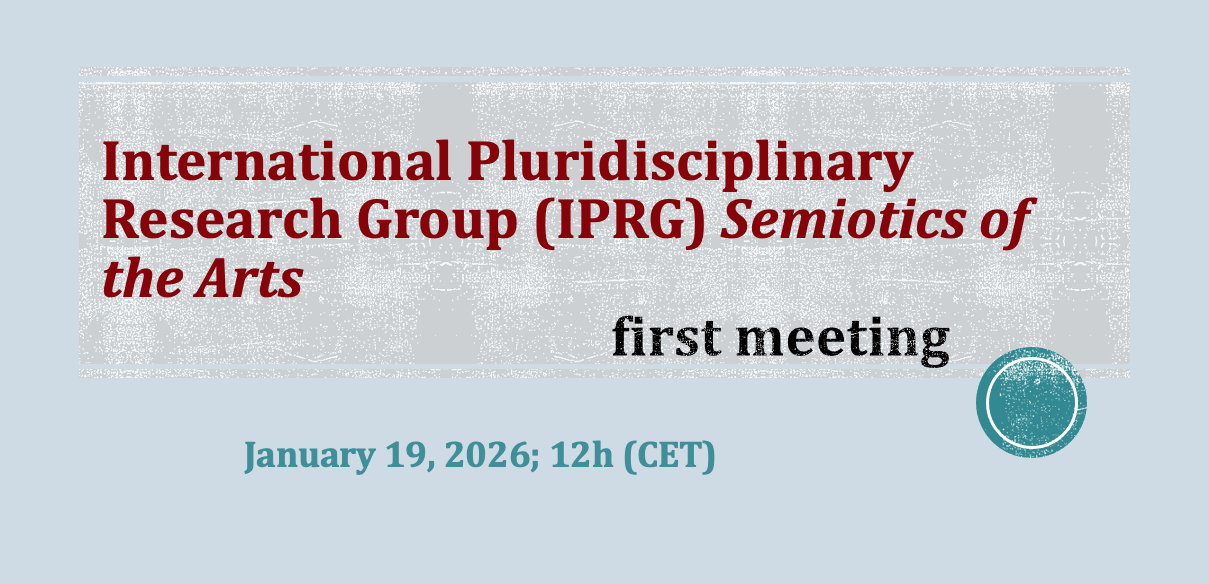
The first meeting was held on Monday, 19 January 2026 via Zoom.
Workshops 2026 (via Zoom):
May 9 (Saturday) Arts, Semiotics and Reality(ies) Part 1 at 10:00 AM Warsaw time
May 23 (Saturday) Arts, Semiotics and Reality(ies) Part 2 at 2 PM Warsaw time
June 13 (Saturday) Arts, Semiotics and Emotions/ Feelings / Sentiments / Inner Life, etc. at 2PM (Warsaw time) and June 20, at 10 AM Warsaw time
June 27 (Saturday) Arts, Semiotics and Communication at 10:00 AM Warsaw time and July 4, at 2 PM Warsaw time
Contact: malgorzata.gamrat@kul.pl
I Workshop
Arts, semiotics and reality(ies): Mapping the reality(ies)
Reality(ies) has been a fundamental topic in both semiotics and arts studies since the very beginning, and there are a myriad of publications which examine this issue from various aspects. Our research group is composed of scholars from various fields of research, such as semiotics, linguistics, philosophy, and different areas of studies of the arts. This is thus an amazing opportunity to ask questions about the way in which we understand reality(ies) in our various fields of research and which tools we use to analyse and describe it/them. We can also ask what the interactions between the arts and reality(ies) actually are. If we see the arts as tools of communication which use different signs, systems and codes, we can then ask about those elements in each of the arts and how we can find a common “language” to describe them. Semiotics which is rooted in linguistics and philosophy and which chiefly focus on the investigation of reality(ies) could also help us do so.
This workshop is divided into two parts in which I propose discussing some fundamental issues. The first one is a more theoretical approach to reality, arts and semiotics, whilst the second is a more practical approach to a semiotic analysis of reality(ies) in arts. It can be held over one or two days, depending on our capacities to work on these topics.
Part 1 May 9, 2026
Schedule
10:00 AM (Warsaw time) General introduction
10:15 First round table – participants’ answers to the following question:
What do we understand as reality through our fields of research?
11:15 Discussion
11:45 coffee break
12:00 Discussion on the text:
José Luis Caivano, “Semiotics and reality”, Semiotica, Vol. 97, No. 3–4, 1993, pp. 231–238:
12:45 lunch
2:00 PM Work in groups on the following issues:
In which ways can we understand / describe reality(ies) through arts?
* what is reality(ies) in the arts?
* which connection can we find between the arts and reality(ies)?
* how can we understand the reality(ies) created by the arts?
* in which ways do art(s) react when faced by reality(ies) and by which means?
* can the arts help us to understand the world and reality(ies)?
2:40 Presentation of answers and discussion
3:30 coffee break
3:45 Second round table – participants’ answers the following question:
Which tools do we use in our research practice to analyse and describe reality(ies) in our fields of research?
4:40 discussion and conclusion of part 1
Part 2 May 23, 2026
Schedule
2:00 PM (Warsaw time) Introduction
Working on texts:
José Luis Caivano, “Coincidences in the Syntactics of Diverse Systems of Signs Used in Architecture, Visual Arts, and Music”, Semiotics1989, J. Deely, K. Haworth, T. Prewitt (eds.), Lanham / New York / London: University Press of America, pp. 175-184.
John Deely, “Objective reality and the physical world: relation as key to understanding semiosis”, Green Letters: Studies in Ecocriticism, Vol. 19, No. 3, pp. 267–279.
Discussion on those texts in order to choose the best tools for work on arts and reality(ies).
2:45 coffee break
3:00 PM Work on the following issues:
Tools and codes used by artists to present reality(ies):
* what do we understand as a sign, code or system in various arts?
* how do codes and signs function in an artistic reality?
* in which ways do artists encode reality(ies) and in which way do receivers decode these codes and signs?
* do we find cultural practice and codes in the arts?
* can art influence reality and its perception (artistic languages and the perception of reality)?
3:45 coffee break
4:00 PM Work on art works chosen and presented by participants in order to apply our tools and knowledge to analysis arts and reality(ies).
5:00 PM End of workshop
Meet the Masters
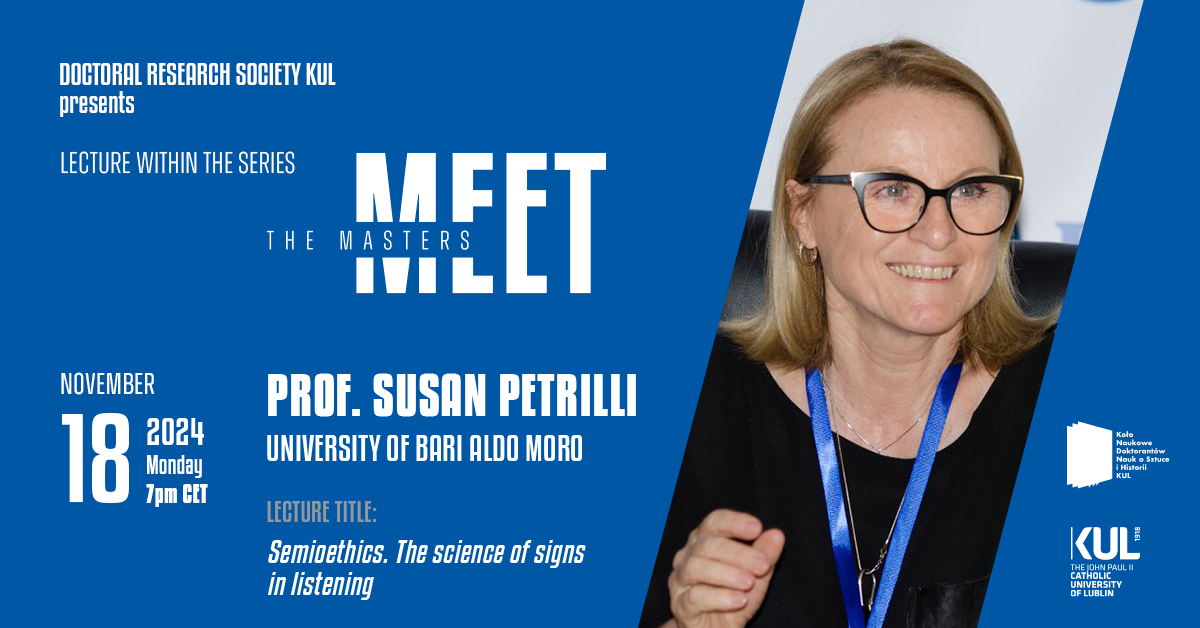
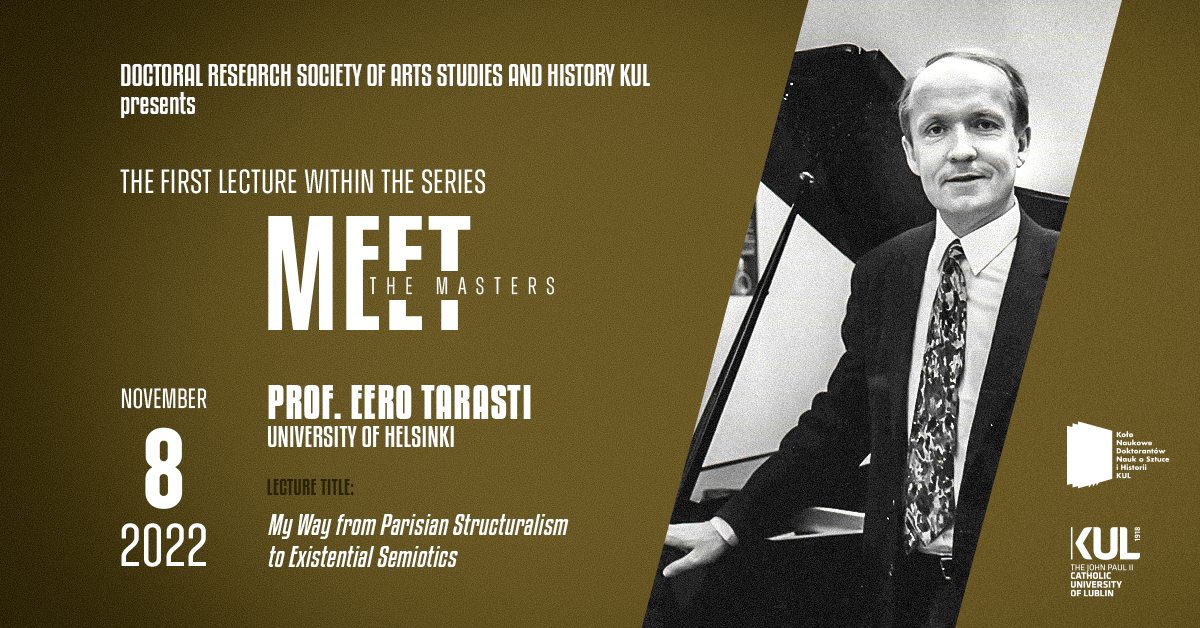
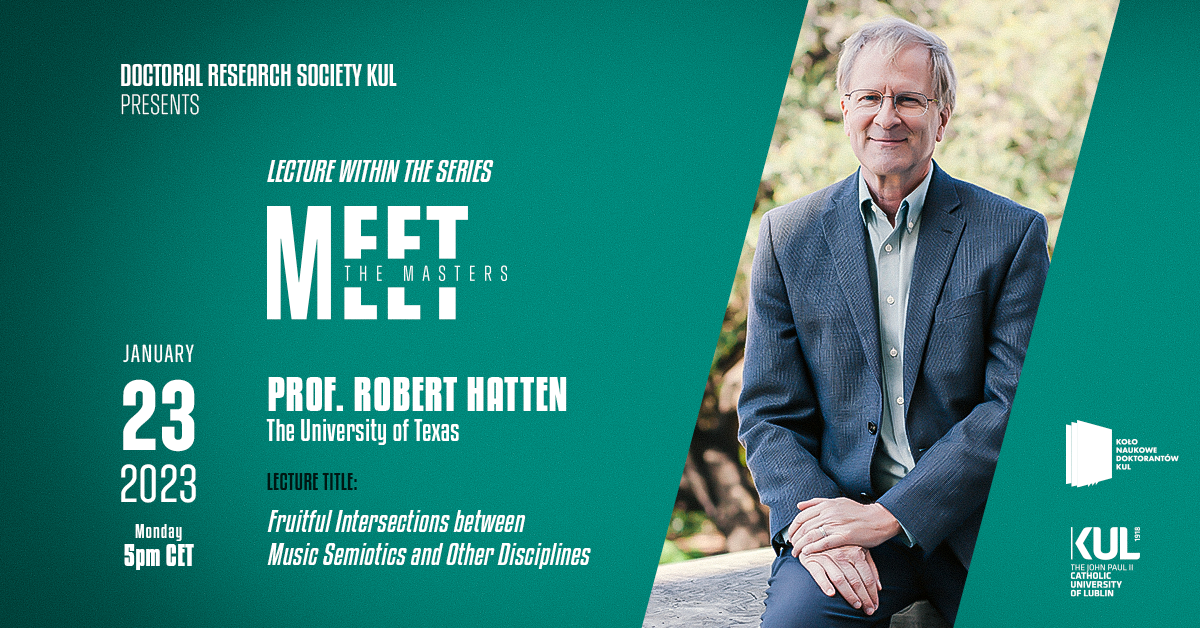
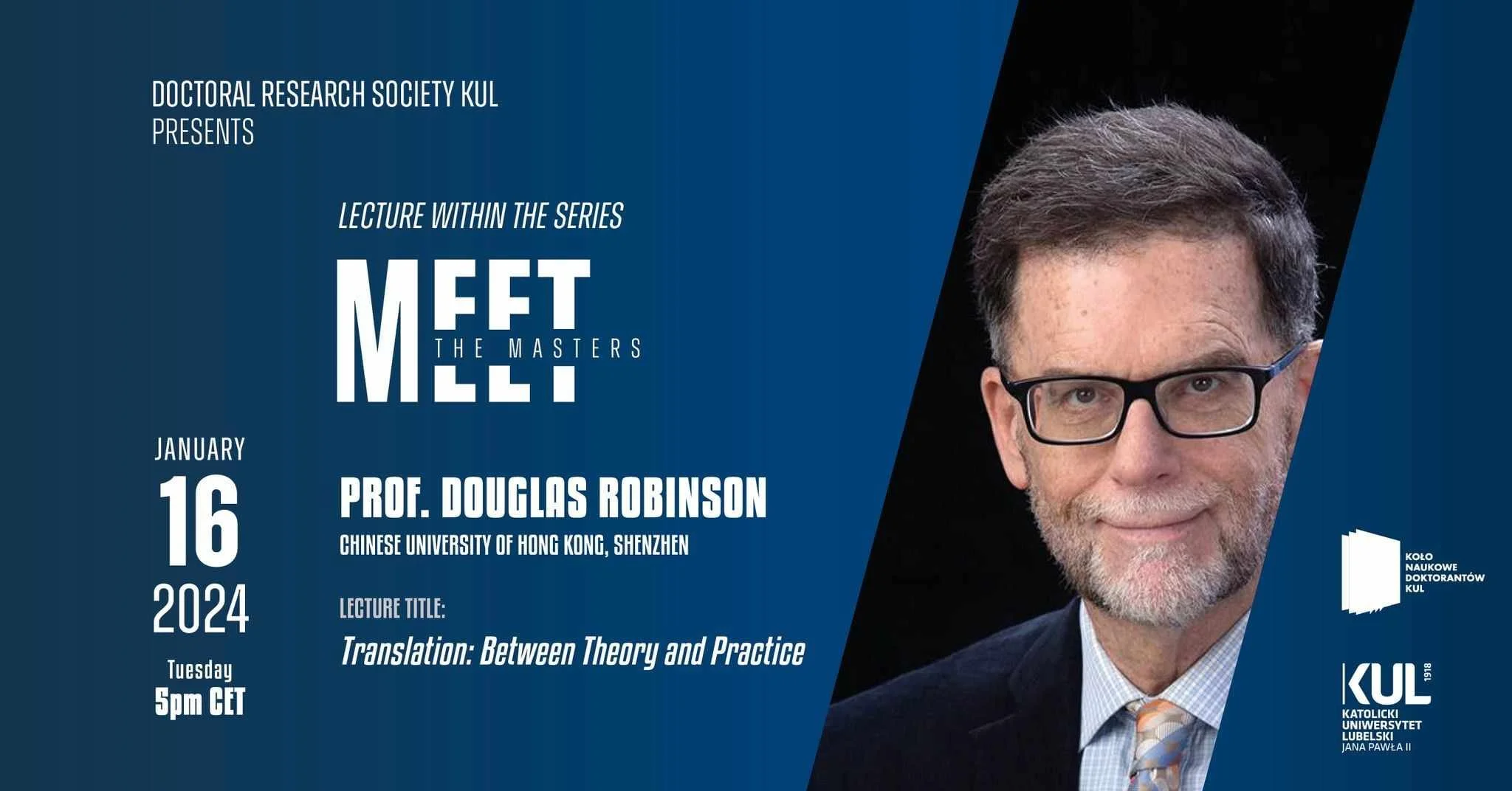
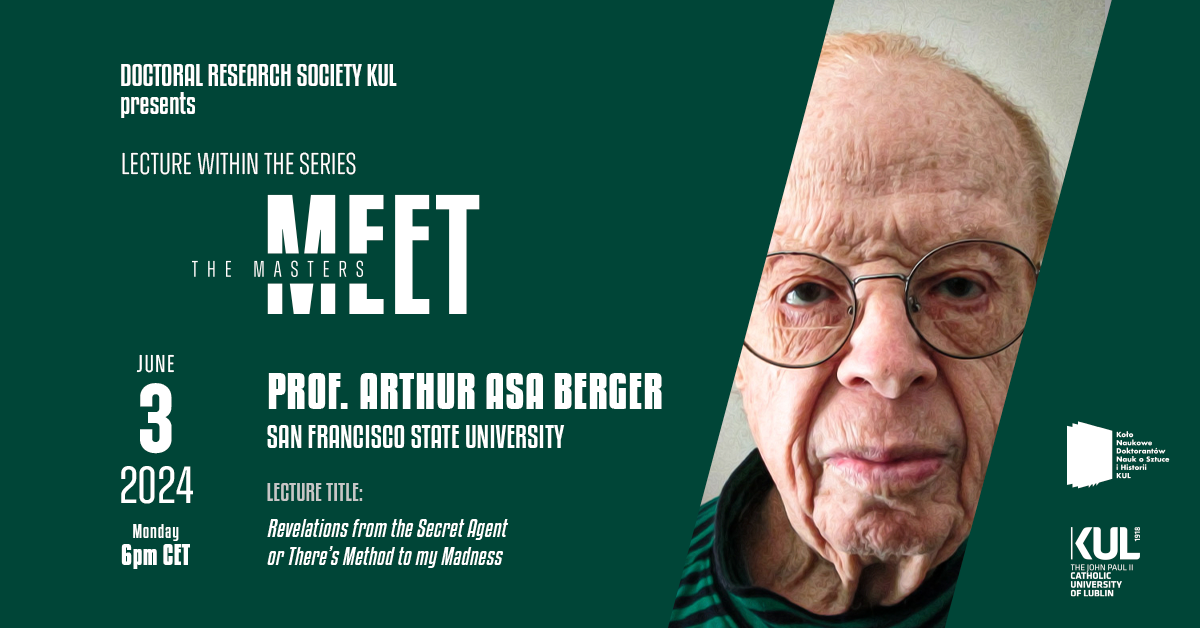
The series of lectures "Meet the Masters" was organized by the Doctoral Research Society of the John Paul II Catholic University of Lublin and supervised by Professor Małgorzata Gamrat. The series was aimed at all PhD students, academics, researchers, and students, especially those interested in interdisciplinary research. During those lectures we had a pleauser to listen to freat semioticians such as: Eero Tarasti, Robert Hatten, Kobus Marais, Douglas Robinson, Arthur Asa Berger, Susan Petrilli, and Paul Cobley. Some of lectures are available on-line.
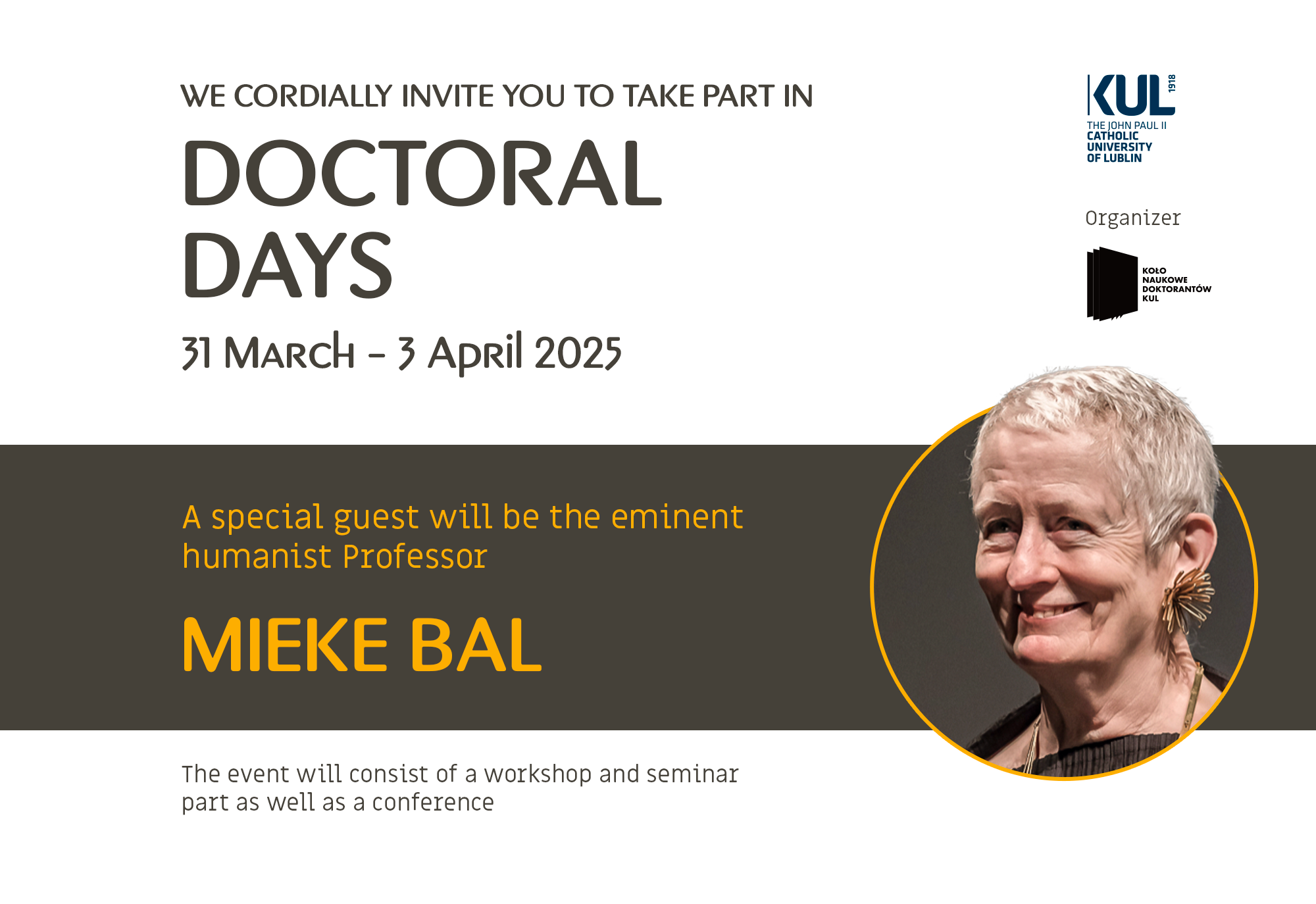
31 March 2025: Doctoral Days’ opening lecture: “Art of Sadness”
Previous activities
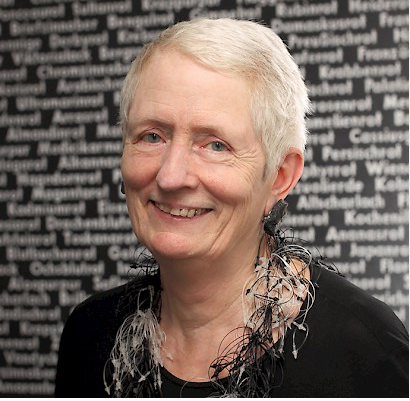
Mieke Bal in Lublin
31 March - 4 April 2025
3 April 2025: Doctoral Days’ closing lecture: “Art and/as Thought: Image-Thinking for Art’s Political Relevance”
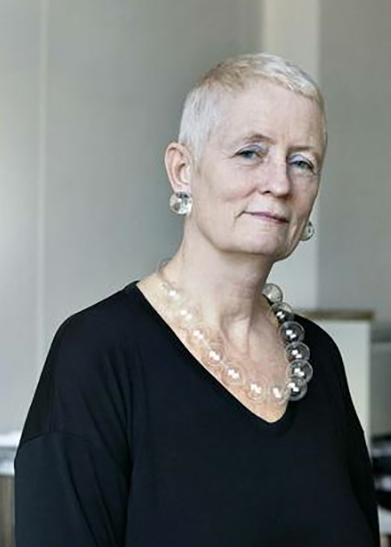
4 April 2025: “Art and Today's World: A Humanist in the Gallery” – Mieke Bal in an interview with Małgorzata Gamrat